A Complete Guide to Robotic Cutting Systems: Laser, Plasma, and Waterjet Technologies
What Are Robotic Cutting Systems?
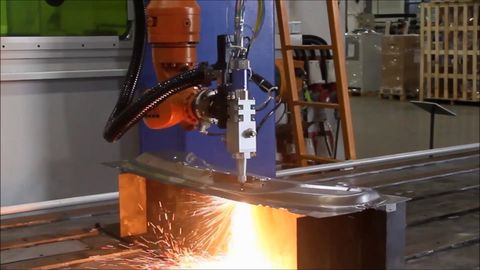
Robotic cutting systems use programmable robotic arms equipped with cutting tools to perform automated cutting operations. These systems can handle a wide variety of materials and shapes, from flat sheets to complex 3D components.
Unlike fixed CNC tables, robotic systems offer greater flexibility. The robot arm can move in multiple axes, allowing it to cut curved surfaces, irregular shapes, and large structures efficiently.
How Robotic Cutting Systems Work
Although different technologies are used, most robotic cutting systems follow a similar workflow:
1. Design and Programming
A CAD model is created and converted into instructions for the robot.
2. Robot Path Planning
Software determines the optimal cutting path and tool orientation.
3. Automated Cutting
The robotic arm moves along the programmed path while the cutting tool performs the operation.
4. Material Removal
Depending on the technology:
- Laser melts or vaporizes material
- Plasma melts and ejects material using ionized gas
- Waterjet erodes material using high-pressure water
Automation improves consistency, reduces errors, and increases production speed.
Types of Robotic Cutting Technologies
1. Robotic Laser Cutting
Laser cutting uses a focused beam of light to cut or engrave materials.
Key Characteristics:
- High precision and clean edges
- Suitable for thin to medium materials
- Minimal finishing required
Laser systems are widely used for detailed and high-quality parts where accuracy is critical.
2. Robotic Plasma Cutting
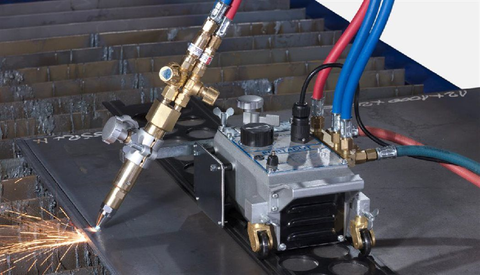
Plasma cutting uses ionized gas (plasma) at extremely high temperatures to cut conductive materials.
Key Characteristics:
- High cutting speed
- Effective for medium to thick metals
- Lower cost compared to laser
Plasma cutting is commonly used in heavy fabrication and structural steel work.
3. Robotic Waterjet Cutting
Waterjet cutting uses high-pressure water (often mixed with abrasives) to cut materials.
Key Characteristics:
- No heat generation (cold cutting process)
- Can cut almost any material
- High precision and smooth edges
Waterjet systems operate at pressures up to 30,000–90,000 PSI and can cut metals, composites, stone, and glass.
Comparison of Cutting Technologies
| Feature | Laser Cutting | Plasma Cutting | Waterjet Cutting |
|---|---|---|---|
| Material Compatibility | Metals & some non-metals | Conductive metals only | Almost all materials |
| Precision | Very High | Medium | Very High |
| Cutting Speed | High | Very High | Low |
| Thickness Capability | Low–Medium | Medium–High | High |
| Heat Impact | Low | High | None |
| Cost | High | Moderate | High |
Laser offers precision, plasma offers speed, and waterjet offers versatility without thermal damage.
Benefits of Robotic Cutting Systems
1. High Precision and Consistency
Robots follow programmed paths with high accuracy, ensuring repeatable results.
2. Flexibility
Robotic arms can cut complex 3D shapes and irregular geometries.
3. Increased Productivity
Automation reduces manual labor and increases output.
4. Reduced Material Waste
Accurate cutting minimizes scrap and improves material utilization.
5. Improved Safety
Automation reduces direct human exposure to cutting operations.
Limitations and Challenges
1. High Initial Investment
Robotic systems and integration costs can be significant.
2. Programming Complexity
Advanced programming and setup are required for optimal performance.
3. Maintenance Requirements
Robotic arms and cutting tools require regular servicing.
4. Space Requirements
Industrial robotic systems need sufficient installation space.
5. Technology Limitations
Each cutting method has material and thickness constraints.
Industrial Applications
Robotic cutting systems are widely used in:
1. Automotive Industry
Cutting body panels, frames, and components.
2. Aerospace
Producing high-precision components and composites.
3. Metal Fabrication
Cutting structural parts and custom designs.
4. Construction
Processing steel beams and pipes.
5. Packaging and Foam Industry
Cutting foam and soft materials for packaging solutions.
Latest Trends and Innovations
1. AI and Smart Automation
Advanced software enables real-time adjustments and predictive maintenance.
2. Multi-Axis Robotic Systems
Robots with 5–7 axes allow complex 3D cutting.
3. Hybrid Cutting Systems
Combining laser, plasma, and waterjet technologies in one setup.
4. Digital Twin Technology
Simulation tools help optimize cutting processes before execution.
5. Energy Efficiency Improvements
New systems reduce energy consumption and operating costs.
Key Features to Consider
When evaluating robotic cutting systems:
Performance Factors
- Cutting accuracy and tolerance
- Speed and throughput
- Material compatibility
System Design
- Number of robot axes
- Reach and working envelope
- Integration with CNC or CAD systems
Operational Considerations
- Energy consumption
- Maintenance requirements
- Ease of programming
Safety Features
- Emergency stop systems
- Protective enclosures
- Ventilation and fume extraction
Checklist for Evaluating Robotic Cutting Systems
- What materials need to be cut?
- What thickness range is required?
- Is high precision necessary?
- What is the production volume?
- What is the available budget?
- Is automation required?
- Are skilled operators available?
Common Companies and Solutions
Several global companies offer robotic cutting systems:
- ABB Robotics (industrial robotic automation)
- KUKA (robotic manufacturing systems)
- FANUC (robotic automation and CNC systems)
- Yaskawa Motoman (industrial robots)
- Hypertherm (cutting technologies including plasma systems)
These companies provide robotic solutions integrated with laser, plasma, and waterjet technologies for industrial applications.
How to Choose the Right Robotic Cutting System
1. Based on Material Type
- Metals: Plasma or laser
- Non-metals or mixed materials: Waterjet
2. Based on Precision Needs
- High precision: Laser or waterjet
- Moderate precision: Plasma
3. Based on Budget
- Lower budget: Plasma systems
- Higher budget: Laser or waterjet
4. Based on Production Volume
- High volume: Fully automated robotic systems
- Low volume: Semi-automated systems
5. Based on Application Complexity
- Simple cuts: Plasma
- Complex shapes: Laser or waterjet
Tips for Best Use and Maintenance
1. Regular Calibration
Ensure the robotic arm and cutting tool are properly aligned.
2. Optimize Cutting Parameters
Adjust speed, pressure, and power settings for different materials.
3. Maintain Cutting Tools
Replace worn nozzles, lenses, or electrodes regularly.
4. Monitor System Performance
Track output quality and efficiency metrics.
5. Train Operators
Proper training improves safety and system performance.
Frequently Asked Questions
1. What is the main advantage of robotic cutting systems?
They offer automation, precision, and flexibility for complex cutting tasks.
2. Which cutting method is best for all materials?
Waterjet cutting is the most versatile and can cut almost any material.
3. Is robotic cutting better than CNC cutting?
Robotic cutting offers greater flexibility, especially for 3D shapes, while CNC is better for flat surfaces.
4. Does robotic cutting require skilled operators?
Yes, programming and maintenance require trained personnel.
5. What industries benefit the most?
Automotive, aerospace, metal fabrication, and construction industries benefit significantly.
6. Is waterjet cutting better than laser or plasma?
It depends on the application. Waterjet is best for heat-sensitive materials, while laser and plasma are faster for metals.
Conclusion
Robotic cutting systems represent a significant advancement in manufacturing technology, combining automation with powerful cutting methods like laser, plasma, and waterjet. Each technology offers unique advantages—laser for precision, plasma for speed, and waterjet for versatility.
Choosing the right system depends on material type, production requirements, budget, and desired level of automation. While robotic cutting systems require an initial investment and technical expertise, they provide long-term benefits in efficiency, quality, and scalability.
As industries continue to adopt automation and smart technologies, robotic cutting systems are becoming an essential part of modern manufacturing, enabling businesses to meet increasing demands for precision and productivity.